Living in Ordinary Time

“You need to let the little things that would ordinarily bore you suddenly thrill you.”

Andy Warhol’s wise words

There is a season in the liturgical church calendar called Pentecost or Ordinary Time. Ordinary Time runs through the summer until Thanksgiving. I love the seasons of the church, especially Advent in December while we anticipate Jesus, both in remembrance of his birth and in waiting for his return. I also don’t mind Lent, the period of self-examination before the celebration of Easter. But Ordinary Time- no. I’ve always found it too long, too dull and too boring. I’ve changed my mind this summer. As a church, we are reading two short but impactful books: A Theology of the Ordinary by Julie Canlis and The Liturgy of the Ordinary by Tish Harrison Warren. Both books take the Ordinary and expand it into healthy relational living for all time.
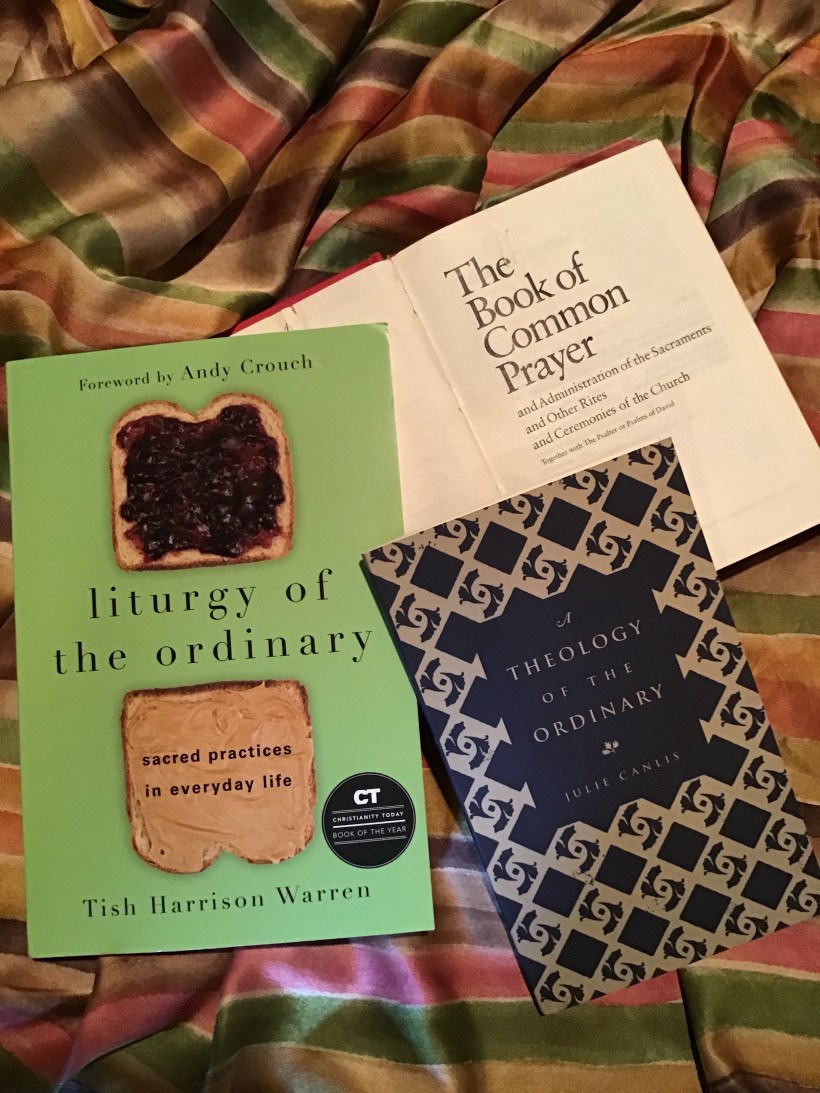
Canlis’s book is only 68 pages because it was originally part of a lecture series at Whitworth University in Spokane, Washington. Canlis regularly quotes Michael Horton, author of Ordinary. One of the best quotes is, “My concern is that the activist impulse at the heart of evangelicalism can put an enormous burden on people to do big things when what we need most right now is to do the ordinary things better. We can miss God in the daily stuff, looking for the extraordinary Moment…” Canlis connects the work of the Trinity to our living of our ordinary lives. For example, God’s creation connects us to our physicality, Jesus’s birth blesses and sanctifies our humanity because he became fully human. His baptism teaches us to hear that we are beloved. She is especially gifted in making these aspects of theology easy to understand for us non theologians.

Warren’s subtitle is “sacred practices in everyday life” which is a great way to describe her thesis. In the forward, Andy Couch writes that Warren “connects the moments of an ordinary day with the extraordinary pattern of classical Christian worship.” Our lives are not really divided into secular everyday time and spiritual Sunday time. She talks about looking “for God in the cracks of my day…[W]e live in a brutal world. But in the life of Christ and the work of the Holy Spirit we glimpse redemption and participate in it.” We need a way that is “neither frantic activity or escape from the workaday world…marked by freedom from compulsion and anxiety because it is rooted in benediction- God’s blessing and love.”

These two books alongside God’s healing in my life have helped me wrap my head around this Ordinary Time living. God’s been using my circumstances to restrict my life long striving and has made me learn to be and not just do. I’ve finally learned to honor my introspective self by giving myself time for reflection and meditation. I’ve enjoyed my simpler living. Cheryl Strayed, author of Wild, says, “The useless days will add up to something. These days are your becoming.” Useless here could translate as the ordinary simple days of living.

The church calendar with its seasons and the liturgy of worship gives my intellectual side a structure which frees my creative side to relax and worship in heart and spirit. There’s space that I don’t have to manufacture from within. Canlis and Warren have helped deepen my appreciation of these structures. Though the books are very different from each other, they serve as great companion pieces. I highly recommend both to someone looking to deepen and enrich their “ordinary” life.
#juliecanlis #atheologyoftheordinary #tishharrisonwarren #liturgyoftheordinary

#sacredpracticesineverydaylife #pentecost

Summertime Fiction #3

“My idea of comfort is a good lamp to read by.” Lucien Rees Roberts

The Prague Sonata by Bradford Morrow

This is a fabulous novel by an author I have not read before, but I’m about to start reading The Forgers which Morrow published in 2014. I think I’m really onto something with this guy! It took him over 12 years to write The Prague Sonata, so you know its well done.

The Prague Sonata is set primarily in Prague, of course from World War 1 to contemporary times. The plot follows Otylie Bartosova’s life during the turbulent 20th century. This sonata written by an anonymous 18th century composer was given to Otylie by her father during WW1. To keep it safe during the German occupation of WW2, she divides it into its three movements, giving a movement each to her resistance soldier-husband, her best friend Irene and keeping one for herself.

So how does the middle movement end up in NYC in 2000 in the hands of musicologist Meta Taverner? Does Meta really think she can locate the other two movements and then determine the composer? Could it really be written by Beethoven or Mozart? Is this wild-goose chase really worth uprooting her life and moving to Prague?

I finished this novel several weeks ago, and I still miss these characters, especially Otylie and Garrett. Morrow’s descriptions of people, places and music are absolutely beautiful, yet the pace never bogs down. Classical music lovers, this is a must-read for you, but it will be enjoyed by all who love historical fiction.

Less by Andrew Sean Greer

Andrew Less, the main character and struggling author is frantically searching for seemingly valid excuses to regret his long-time exboyfriend’s wedding. Basically he decides to accept several literary engagements that are scattered around the globe- from Paris to Berlin to Morocco to India to Japan. Andrew Less is a “Keystone Cop” who goes from one amusing mishap to another. What makes him so endearing is that he is such a worry-wart. I come from a long line of worry-warts, and Andrew almost takes the cake! Yet in spite of all his worrying, he maneuvers life with grace and humility. This 2018 Pulitzer winner as a great pool-side read.

The Overstory by Richard Powers

I’ve never read a book quite like The Overstory. A book blurb says, “A monumental novel about reimagining our place in the living world by one of our most ‘prodigiously talented’ novelist.” The format is fascinating in how Powers splits up the book in different fables about various individuals who have life-changing experiences with trees and how these experiences shape their lives. For Mimi, it’s the mulberry in the backyard that symbolically honors the silk made by her Chinese ancestors. For Nick, it’s the elm growing in the yard of his inherited farmhouse in the Midwest that was planted by his great grandfather. Their family elm flourished while the elms died off by blight in the northeast. All the book’s characters feel a deep attachment to creation through their special trees, except Neelay.

Neelay falls out of his tree as a boy and is now a wheel-chair bound paraplegic IT whiz. He is a mega-wealthy developer and owner of a virtual reality video game conglomerate. His games are so realistic he spends most of his waking hours in a reality of his own making. Neelay reminds me of Jake Sully, the paraplegic vet in James Cameron’s movie Avatar. Both characters can live and move in their virtual realities. Both rebel against their cruel realities. Neelay has some redemption in the end and though it seems a little disjointed, it’s welcomed all the same.

Powers wonderfully and believably brings these various people together to try and save one of America’s last virgin forests in the American Northwest. It ought to be a Pulitzer winner in my humble opinion. It’s disturbing and thought provoking in all the ways a good novel should be.

#fiction #bradfordmorrow #andrewseangreer #richardpowers #thepraguesonata

#less #theoverstory

My Shame Meets Brene

“She could never go back and make some of the details pretty. All she could do was move forward and make the whole beautiful.” Terri St. Cloud

She could never go back and make some of the details pretty. All she could do was move forward and make the whole beautiful.” Terri St. Cloud

The financial crash that began in 2008-2009 has had a harrowing effect on my finances and lifestyle. The consequences have made this past decade “rich”in learning experiences for me. I have had to learn a new way to live internally and externally. I’ve had to learn to wrestle with my demons of shame and perfectionism. I’ve had to learn to live above trying circumstances by developing a lifestyle of gratitude.

I remember the day several years ago when a friend mentioned listening to a TEDtalk by a woman named Brene Brown. I had never heard of TEDtalks or Brene, but that night I listened to her talk on vulnerability. Life had broken me open enough to want to learn and change. Since that night, I’ve listened to all I can find and read most of her books. I’m a Brene groupie.

I was on the “unraveling journey” Brene writes about in The Gift of Imperfection.I was a classic case. “Shame is the birthplace of perfectionism” which our attempt to block any pain coming from blame, judgment and shame. Unfortunately it is an ineffective attempt. Shame only paralyses us. In Rising Strong, she says to ask not ‘what will people think?’, but instead ask ‘how can I be my best self?’ Also ask yourself what story you are telling yourself, what is your internal narrative? These questions are a thread throughout her work. We have to own our stories by “reckoning with our feelings and rumbling with our dark emotions- our fear, anger, aggression, shame and blame.”

I had to own my story of financial loss, embarrassment, shame and fear. I began by owning up to my grown children, then my sister, then my close friends, then trusted colleagues. I can’t say it got easier, but I got stronger and healthier. Brene is right- “shame and fear can’t tolerate powerful connections between people.” Shame can’t survive out in the open, being spoken aloud, and “emotional stoicism is not badassery.” Badassery is coming clean, raw honesty and vulnerability. And yes, it’s scary to do. However the flip side of vulnerability is joy. Adela Rogers St. John says, “Joy seems to me a step beyond happiness…joy is a light that fills you with hope and faith and love.”

Joyful living is wholehearted living. It’s living from a deep well of “worthiness, courage, compassion and connections.” Graham Cooke, another writer/teacher who has influenced me, says life is not about resolution of hard circumstances. It’s about learning to overcome, learning to live above our circumstances, to practice joy and gratitude. The process of hard times helps us redevelop our identities, to help us see the benefits of grateful living. Brene puts it this way, “…the process of regaining our emotional footing in the midst of struggle is where our courage is tested and our values are forged. Rising strong after a fall is how we cultivate wholeheartedness in our lives; it’s the process that teaches us the most about who we are.”

#brenebrown #risingstrong #thegiftofimperfection #grahamcooke #brilliantbookhouse

More Good Summertime Reading

I’ve read several good books in the past few weeks. I want to share three of them today.

The Extraordinary Life of Sam Hell– Robert Dugoni

Dugoni is a mystery writer, but he moves in a different direction with this coming of age book. It is well written with great characters, particularly Sam Hill, aka Sam Hell. Sam has ocular albinism which is a rare genetic disorder which usually affects males. It’s a complicated disorder, but for the purpose of the plot it only affects the color of Sam’s eyes- they are red, as in the pupils are red. Hence many nicknames, like Devil Boy and using Hell instead of Hill as his last name. Sam’s mother is a steadfast character of remarkable faith who believes her son will live an extraordinary life and its God’s will that Sam was born with red eyes. Not that Sam buys any of this, not when his life is full of bullies, including the nun who is his principal! Sam becomes an ophthalmologist in his home town until…..he takes off running away. While serving as an ophthalmologist in the developing world, Sam meets a Central American orphan boy. It’s then that Sam’s life takes on an extraordinary richness he never imagined. Heartwarming and redemptive.

Lisette’s List– Susan Vreeland

One of my favorite kind of novels- French villages, art and love! The story is set in Roussillon, a quaint village in Provence and Paris during the 1930s and 1940s. Lisette Roux and her husband Andre move to Roussillon to care for Andre’s aging grandfather Pascal. Pascal, a frame maker and ocher miner, who befriends Impressionist, Post Impressionist and Modernist French painters. He amassed quite a little collection of some of the greatest painters of this time. When World War 2 breaks out and France is invaded by Germany, the paintings are hidden by Andre to keep them out of the hands of the art-grabbing Nazis. When Andre dies in battle, the secret location of the paintings dies as well. Thus begins a decades-long search by Lisette to recover the paintings. What she finds along the way is love and acceptance as she learns to live again in the post-war years. You will cheer her on!

Warlight– Michael Ondaatje

Ondaatje is also the author of an all-time favorite, The English Patient. Warlight is set in the murky years of World War 2 in London and surrounding countryside. If it’s made into a movie, it will be called a ‘film noir’. Until then, we’ll call the book a ‘novel noir’- it’s secretive, shadowy, ambiguous, winding and beautifully poetic. It’s a coming of age story, a spy novel, a war novel, a family tragedy all rolled into one. Told by Nathaniel in real time and recollections, it’s a story of a brother and sister who are abandoned by their parents. Nathaniel never stops trying to piece together who his parents really were, what were their roles during and after the war, and who were these strange guardians. It is not told in a clear cut manner, so just meander through the confusion of the war years and the memories of a scared boy.

#theextraordinarylifeofsamhell #robertdugoni #lisetteslist #susanvreeland #warlight #michaelondaatje #fiction

Children and Trauma- an interview with Eleanor Striplin Brindle

This is a hard topic because it’s human nature to avoid pain and to dissociate from painful information and conversations. But it’s important for us, as privileged safe people to open our eyes to suffering.” Eleanor Striplin Brindle

This week I interview my daughter Eleanor Striplin Brindle who did humanitarian work in the Middle East for several years. In 2015, Eleanor was part of two trauma workshops in Erbil, Iraq for Iraqi girls who had been captured and made into sex slaves by ISIS. These girls were part of the Yazidi people group whose men were mass murdered as part of ISIS’ s ethnic cleansing. These girls and women were taken into slavery and routinely raped and physically tortured. Eleanor also organized and led an art therapy program for Syrian refugee children in 2016. She has seen first hand the deep wounds caused by trauma. She is presently working towards an MS in Psychology with an emphasis in crisis management and trauma.

Eleanor, how did you get involved with art/dance therapy as part of trauma healing?

I have always been interested in post-conflict resolution. My senior project at George Mason University was on art therapy and refugees. After college, I really didn’t have an immediate outlet for this interest. I didn’t want to go to grad school at the time. I started doing humanitarian work overseas in Turkey. Some ex-pat acquaintances doing humanitarian work in Iraq emailed me in 2015 and asked me to come be a part of a trauma workshop for Iraqi girls who recently had escaped captivity from ISIS. Two weeks later, my husband Patrick and I are flying to Erbil. I participated in a workshop in July of 2015 and then again in November 2015.

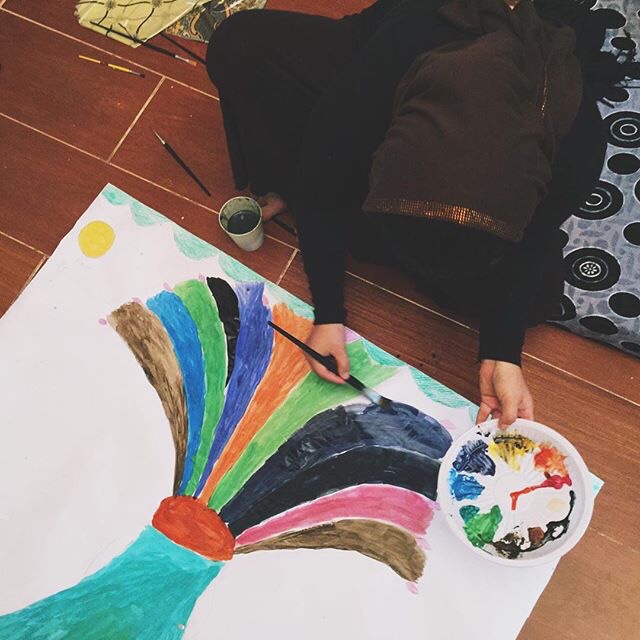
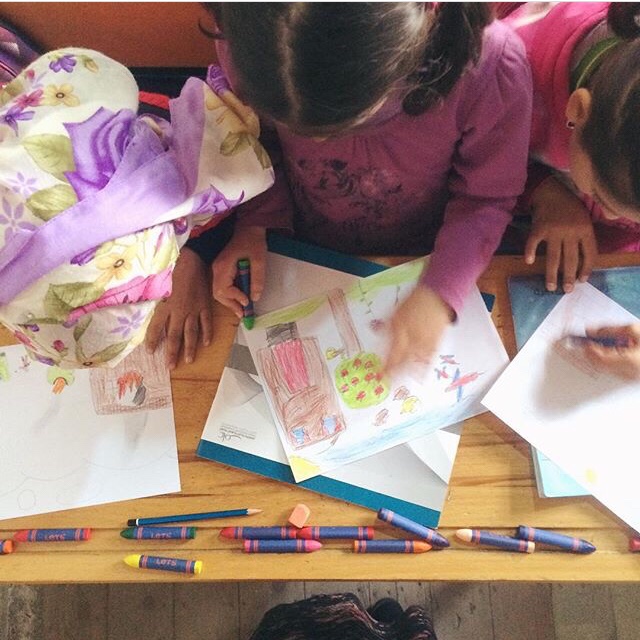
In 2016, I was living in Turkey, and the country had had a huge influx of Syrian refugees escaping the civil war. I realized this was an opportunity to address trauma in children. I put together a team to dialogue with displaced Syrians in my area. The leaders of this refugee community were very interested in our help. The children were in a makeshift school in Pod-like storage containers. We were able to help organize financial assistance for the school and start group art therapy classes for the 7-12 year olds. We routinely worked with three classes of these children for 1.5 years. At that point the Turkish government forced the school to shut down.

How did you prepare yourself for these programs?

Before leaving for Iraq, I binged-read everything I could find online about dance/movement therapy and visual art therapy for groups. I emailed and Skyped with two art therapists in NYC and London. I began to put together a program for the girls in Iraq. As far as the Syrian children in Turkey, I modified the art therapy format for young children. I wrote a field manual on this modified program.

How did you see trauma manifested both physically and emotionally in the young Iraqi women?

In Iraq, the girls were between the ages of 12-22. I vividly remember the first night of the first workshop. They had come from the refugee camp to the safe house where they would stay the 2 weeks for the workshop. The girls were comatose zombies, clearly alive but they seemed mostly dead. They moved very slowly, blank faces, lifeless eyes, frozen like a deer in the headlights. After the two weeks, parts of their personalities were beginning to come back. It takes a very long time to heal from trauma, but the girls showed improvement through the variety of ways they had to express their frozen, pent-up feelings. Also we had a local female doctor who addressed their physical needs which were many as you can imagine.

How were the workshops organized? What programs were offered?

We had a combination of activities that would either help equip them for their future (most were going to relocate to Germany on the invitation of the German government) or that would be good for their souls. Most of these girls had never been educated in any way because their Yazidi tradition did not value teaching girls. So we taught them how to hold a pencil and write their names, they learned basic English words and world geography- these girls had no idea of how big the world is.

As far as the soul-enhancing activities, these included gardening, movement therapy because trauma and all emotions really get stored in the body, and movement helps work out these emotions. They had group art therapy classes because creativity is necessary for mental and emotional wellbeing. One girl commented through a translator that her brother had had a paint set but she wasn’t allowed to use it. This was her first time to release her own creative spirit. The girls also gardened which too relaxes and releases emotions.

We also taught nutrition and hygiene and what that looks like when living in a tent in a refugee camp. They needed to know how to combat illness and disease while living in an overcrowded camp.

Moving on to the art therapy program for the Syrian refugee children, how was their trauma of the war and then being displaced manifested in them?

The principal of the makeshift school was very excited about the art therapy program because they were seeing lots of trauma symptoms in the children. The kids were acting out behaviorally which makes sense because children do not have the necessary verbal or writing skills to effectively express what is going on inside of them. Our classes incorporated creative art activities partnered with play. What is stolen from traumatized children is childhood, and play is a key fundamental aspect of healthy growth. Play restores main components of what has been lost and begins to release stored up emotions in a healthy way. Art and play are perfect avenues for this expression. We sometimes take for granted the benefits of play in a safe western environment, but it is key to have healthy children.

In closing, what kind of treatment is available to groups of traumatized children? We have so many hurting children now, and thanks to instant communication we realize the magnitude.

On the record, I don’t know. There is an emphasis within the field of psychology and child development on the healing of trauma and what that looks like in the developing world. It is a big topic of discussion and research. There is never enough planning, money or people to deal with the enormous problems trauma causes whether man-made or natural disasters. It’s always been part of life, but we are still ill-equipped to handle it. It’s wonderful that there is an emphasis in the field of psychology. Hopefully we asking the right questions which will lead to some solutions. It’s an international problem.

If you have any questions for Eleanor, please ask through the comment section.

All photographs credited to E.S.Brindle

children and trauma- the elephant in the living room


 When we think of trauma or post-traumatic stress disorder, we immediately think of soldiers. We seldom think of a woman who has been raped or a child who has been abused. The subject of children and trauma is the elephant in the living room in our world today. As a society we have to educate ourselves on the lifelong cellular damage of trauma so we can help our leaders make wise and compassionate decisions. So I don’t care if you vote red, blue, green or yellow. I don’t care who you voted for in 2016 or who you will vote for in November 2018. We are all human beings and this is about humanity.

I suspect we have more traumatized children in our world today than ever before. We have Central American children who have been separated from families in SW America, Yazidian girls kidnapped by ISIS being held as sex slaves, Syrian children, Yemeni children, Sudanese children and Rohingyan children all suffering physically and emotionally from war and ethnic cleansing. We have children being held in slavery either as forced laborers or sex workers. The list could go on for a mile.

5FCEAB59-7186-4558-B9FE-E8771211A005

Here’s the deal- traumatized children grow up to be traumatized adults, some of which will be traumatized leaders in their communities and countries. Our world in the near future will be governed by adults who have cellular damage caused by childhood trauma. This will effect how they relate to others and how they process information on a rational and analytical level. As Dr. Bessel van def Kolkata writes in the book, The Body Keeps Score: Brain, Mind, and Body in the Healing of Trauma, “After trauma the world is experienced with a different nervous system. The survivor’s energy now becomes focused on suppressing in chaos…The challenge is not so much learning to accept the terrible things that have happened but learning how to gain mastery over one’s internal sensations and emotions.”

Trauma effects our brain’s right hemisphere which controls our memory, attention span, reasoning, problem solving, communication including non-verbal. We know controlling anger can be an issue for traumatized people, so mix that with problems of reasoning and problem solving and what do you have? Maybe someone we wouldn’t want to be in a leadership role? Maybe someone who thinks war is a quick answer to a dispute? Maybe someone who traumatizes his/her own children? Without long term treatment, trauma perpetuates trauma.

I’ve invited my daughter Eleanor Brindle to join me on my blog next week. Eleanor did humanitarian work in the Middle East for several years. She did art therapy with Syrian children and movement therapy with rescued Yazidian girls. Presently she is back in the States working on a Master in Psychology specializing in Crisis Management and Trauma. She will share some of her experiences and knowledge as well as some books she has found helpful.

Summertime Fiction

I just finished two fun summertime reads: Swimming Lessons by Claire Fuller and How to Stop Time by Matt Haig. Both books are written by award-winning British authors whom I’ve never read before, but will read again. Both have very clever plots which grab you immediately.

Swimming Lessons centers on a dysfunctional family (is there any other kind??) where the mother vanishes leaving two young daughters and an estranged husband. The plot develops in two different time periods- the current with grown daughters and aging husband, and the past with the wife’s letters to her husband before she disappears. Ingrid, the wife hides the letters in the husband’s many books. The letters chronicle Ingrid’s perspective of their life together and some secrets. What kind of secrets, you may ask. Well, secrets that give the plot some twisting, winding turns which moves the book along at a nice clip. Things are not always as they seem. Never believe you have it all figured out. A perfect book for a pool-side, cool-drink kind of day.

Matt Haig’s book is one of my favorite types of books- magic realism mixed with a whole lot of history. Tom, the main character suffers from analgesia, a rare condition that prevents bodily death. Although, he looks 41, Tom has been alive since 1581. Yes, he hung out with Shakespeare, sailed the high seas with Captain Cook, drank gin with Scott and “Zee” in Paris during the Jazz Age. The most interesting historical parts are Haig’s descriptions of London through the centuries. So London aficionados will love the descriptions of the old neighborhoods and architecture. Also Tom is a French Huguenot who escapes to England to avoid Catholic persecution in the 16th century. This is a fascinating time in French history. There are two love stories playing out in two different time periods as well as a long-missing beloved daughter. To spice it up even more, Haig adds some pretty sinister characters in every century to torment Tom.

PONDERING: Some historical fiction is more fiction than history. To help judge accuracy, I always check the author’s acknowledgments to see if she/he credits any historians or librarians for information. If you are lucky, maybe the author will mention specific nonfiction historical references. I have found some great books that way. Of course, google is an invaluable resource.

#clairefuller #matthaig #london #britishauthors

Sobbing Under the Cedars

The other day, my friend Debra and I were riding the backroads of Clarke, Monroe and Baldwin counties. If there is anything we love it’s some backroads and a general idea. Thanks to Debra on this particular day we hit an historical jackpot. The sister of the Union General George B. McClellan is buried in the middle of nowhere Alabama. And how, pray tell, did this anomaly come to be?
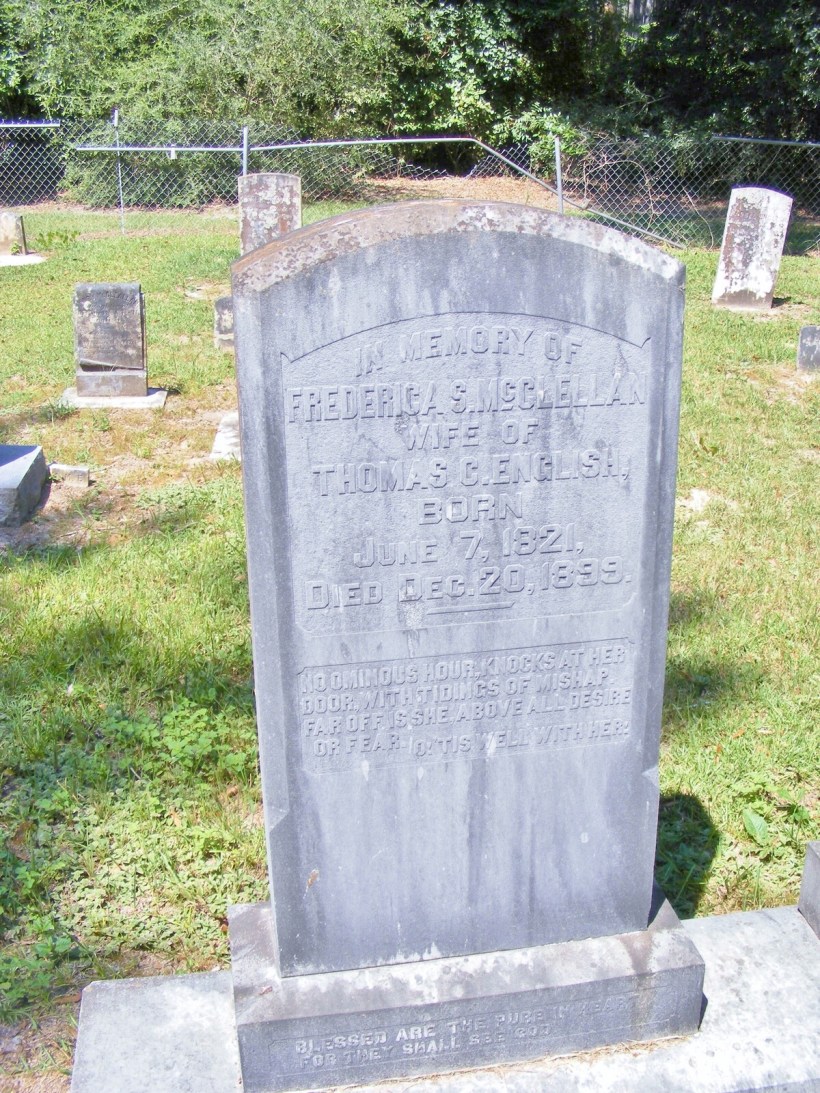

It started with the love affair and subsequent marriage in 1840 of Alabama- born Thomas Cassander English and Philadelphia socialite Frederica Sarah McClellan. The lovebirds met at dinner at her parents’ home while Tom was attending medical school in Philadelphia. They married before Tom finished his studies and moved to Cedar Hills Plantation in Eliska, Alabama. City girl was now isolated in the middle of nowhere as the wife of of a slave-owning plantation owner. Frederica had a difficult time adjusting to the isolation, the foreignness of slavery, different social customs, and all the while missing her family and friends in Philly. Frederica would sob her heart out under the cedar trees. Tom was sympathetic to his wife and would send her back to Philadelphia for extended stays, in fact a three year old daughter died there during one of these visits. She eventually adjusted and became active in the community while overseeing the welfare of both the white and black folks on the plantation.

When the Civil War broke out, Frederica and children were visiting Philadelphia. Her younger brother General George B. McClellan arranged for them to safely enter what was now the Confederacy. Husband Tom English served in the English Independent Calvary and Watts Rangers as well as supplied material to the Confederacy. Their son, George McClellan English served as 2nd Lieutenant on Company 1of the 31st Alabama Infantry. Son George was captured in the Battle of Big Shanty in Georgia and was sent to the Union POW prison called Rock Island Prison. Story has it that his Aunt Mary Ellen, wife of his uncle General McClellan got word of his capture and sent him a care package though I can’t confirm this. Son George returned home in poor health following the war and died in 1866. My heart hurts for Frederica whose loved ones were so divided and literally fought for two different causes. The McClellan-English families were one of many caught in this dilemma.

In one of the last battles of the war, the Battle of Eliska on April 12, 1865, Union soldiers rode up to Cedar Hills Plantation with orders to burn the house. A slave woman and one of Frederica’s young daughters were on the front porch. The woman told the soldiers that the child was General McClellan’s niece. The soldiers posted a guard on the property to insure the safety of the family and the house. One of the ironies of this story is that General McClellan’s personal property would later be sent to Cedar Hills Plantation. His saddle, uniforms, silverware, books and guns were divided among Frederica’s descendants. The reason- both of the General’s children died childless so he had no direct heirs.

Frederica and her family are buried at Cedar Hills Plantation. The Plantation house burned in the 1870’s, but family still lives on the property. The story is on quiet nights you can still hear Frederica sobbing under the cedar trees. I’ll take Kathryn Tucker Windam’s word for this because I’m not about to try and confirm it!

PONDERINGS: I would love to see a photograph of Frederica’s house. Photography was in its infancy during the 1870’s so there may not be a picture. For those who love old Southern houses, please see Silent in the Land by Chip Cooper, Harry Knopke and Robert Gamble. A beautiful description of this book: “Eloquent in their silence, these houses stand as sentinels over landscapes of memories…Whether abandoned, declining or maintained through generations of living, they all speak volumes about history of the southern countryside, even though these muted structures are silent in the land.” The book is published by CKM Press in Tuscaloosa, AL, and proceeds benefit The University of Alabama Division of Student Affairs.

CREDITS: Thank you to Debra Blackburn for graciously sharing her research on Frederica and to the unidentified descendant of Tom English for sharing his photos and knowledge on civilwartalk.com site.

#alabamahistory #civilwarhistory #southernhistory

#universityofalabama #kathryntuckerwindam

#CKMPressw

Beginnings with Anne Lamott

Welcome to my first blogpost. I have several people to thank for encouraging and helping me find the courage to step out of my comfort zone. First off, to my beloved book club of 20 years, I say thank you for the big push or was that a shove you gave me on May 3rd. Secondly, but equally as important, thank you to my family. My Mother’s Day gift of a new iPad (cause Mama is going to start writing) is particularly appreciated. I could have never begun this adventure without Ellie and Patrick teaching me WordPress and buying my domain name. I’m forever grateful, and I hope to make all of you proud.

Earlier this month, I read Anne Lamott’s book Hallelujah Anyway- Rediscovering Mercy. Where would we be without her biting humor and truth-telling? Lamott discusses mercy in the context of our families, our friendships, and the world at large. AND in the context of ourselves. She writes, “Mercy, grace, forgiveness, and compassion are synonyms, and the approaches we might consider taking when facing a great big mess, especially the great big mess of ourselves- our arrogance, greed, poverty, disease, prejudice.” In these 62 years, I have discovered that loving myself has been the hardest task of life. Self-loathing is exhausting, and we finally have to lay aside that weighty burden, crawl to the throne room of heaven, and let divine love heal us. If God can embrace our messy selves, we can too. It’s about being our own best friend. We can speak the same encouraging, compassionate words to ourselves that we speak to others.

As for friendship, Lamott tells us that, “In rare friendships, we know soul reaches out to soul, like deep calling to deep. The Psalmist wrote: ‘Deep calls to deep, in the roar of your waterfalls.’ He was referring to floods of trouble and sorrow, but we know there is opposite and equal reality. What about our deepest, nethermost selves, beneath the part of us that can be sedated, stupid, reactive, observed, that cries out to that truer place in others?” Soul to soul, deep to deep relationships start and end with a willingness to be vulnerable. Ouch! Scary!

I hear Brene Brown’s TED-talking voice in my head. I’ve spent the last 12-18 months really working at being vulnerable, letting down my perpetual guard, peaking out from under my mask of shame and fear. Working is a good verb here because it’s hard and scary. It takes a lot of effort and energy. And trust. Brown says shame can’t survive when we share our story, our struggles, our fears.

I’ve also noticed shame can’t survive when we share our dreams and desires of our hearts. It’s sharing our most true selves- our deep to another’s deep. When soul connects to another soul, the rewards are bountiful. It’s those moments when we tap into the divine connection, when we share that sacred love, when we recognize that “we all struggle [and are all] as vulnerable as a colony of rabbits.”

Time is needed to foster a relationship where two people can begin to expose their souls to one another. Isn’t that the scarce commodity in this post-modern world? Or is it our excuse so that we don’t have to go deep? Lamott calls us “water skeeters on the surface of the pond, dropping down for a quick bite of insect or email.” This will be the visual in my head next time I pop out a quick text when I really should be calling. I’ll embrace my own foibles as I consciously make the effort of embrace everyone else’s. In parting, let’s remember that “mercy and grace belong together, like cream and sugar.” Be sure and offer it.