Leaf and Amen: You Really Can Change Your Brain

Can you really change your brain? Dr. Caroline Leaf in her book Switch on Your Brain and Dr. Daniel Amen in his book Change Your Brain, Change Your Life say you can. Changing your brain is called neuroplasticity or brain plasticity. I briefly mentioned neuroplasticity last week in the blog on happiness. I talked about changing the fixed point of happiness in our brains. Our brain can “reorganize itself by forming new neural connections throughout life. Neuroplasticity allows the neurons [nerve cells] in the brain to compensate for injury or disease and to adjust their activities in response to new situations or to changes in their environment” (medicinenet.com). New nerve endings grow and reconnect to the nerve cells making new pathways which are stimulated by activity. Before we briefly look at these two books, I’ll interject with an observation by our dear family friend, Katie Nickerson. Katie has been besties with my daughter since they met in 5th grade and due to a rare and chronic illness, Katie began practicing changing her brain. Katie says :

“I became interested in neuroplasticity because of my own health challenges. After about a decade of declining health and consultations with hundreds of doctors, I was diagnosed with a condition called CIRS which is a biotoxin illness in which my body develops sensitivities and reactions to environmental elements such as mold and chemicals. There is no cure according to most doctors but there is a new theory and treatment that considers this illness to actually be a brain injury, a limbic system injury to be exact. I came across the idea of neuroplasticity as I began to research this treatment whose main tenant is that you can rewire your brain to not react to triggers thus healing yourself from this illness.”

Katie shared her books by Drs. Leaf and Amen with me. Both authors recognize toxicity and inflammation caused by stress to contribute to many of our illnesses and diseases. Leaf writes, “stress is a factor in 75 percent of all illnesses and diseases that people suffer today…Research shows 75 to 98 percent of mental, physical, and behavioral illness comes from one’s thought life” because of the negative chemical responses due to toxic thoughts and behaviors. Does this mean we are willing ourselves to be sick or suffer with dementia? No, but what we believe takes on a physical existence in our cells either positively or negatively. Daniel Amen says that negative brain chemistry causes chemical chaos in our bodies. He says holistic health has four healthy components: biological, psychological, spiritual and social. Using anxiety as a simple example, it effects our mind by toxic thoughts which causes a physiological response of tense muscles, GI issues, etc, which ends up making us difficult to live with.

Dr. Leaf writes our “…state of mind is a real, physical, electromagnetic, quantum, and chemical flow in the brain that switches groups of genes on or off in a positive or negative direction based on your choices and subsequent reactions…The brain responds to your mind by sending these neurological signals throughout the body, which means that your thoughts and emotions are transformed into physiological and spiritual effects.” Dr. Amen’s book talks a lot about the chemical breakdown in the different parts of the brain and shows us what natural chemicals we are missing as evidenced by our thoughts and actions. These missing chemicals can be added via supplements or medicine such as SSRIs. The missing chemicals show up in ADD, dementia, depression and anxiety, and dyslexia. Many of his suggestions you can do on your own.

Which leads us into all kinds of side discussions like “leaky gut”, gluten intolerance, in-season nutrition, C-section babies missing the mother’s microbiomes by not coming through the birth canal, brain injuries in athletes and soldiers and so on. We need to pay attention to what applies to us and our families. One of these side discussions I’ve been experimenting with is binaural beat music to increase gamma waves or alpha waves or whatever waves you might think you could use more of. I like the gamma wave part because gamma waves (fastest brainwave frequency) is associated with deep meditation/prayer, intense concentration, memory and cognitive functioning. Some believe gamma wave therapy can remove the brain plaque that causes Alzheimer’s. Leaf has a 21-day program to stop toxic thoughts and replace them with healthy thoughts which Katie is doing. So far so good with Katie, and we are rejoicing with her improvement.

I’m pondering: I read recently that about the time Henry the 8th began flirting around with Jane Seymour and becoming discouraged that Anne Boleyn had not given him a son, he had a serious fall from his horse while hunting. He was unconscious for over 2 hours. Contemporaries said he was never the same after that fall. His personality and behavior changed. He became cruel and violent, and hence Anne lost her head.

#carolineleaf #danielamen #neuroplasticity

Frederic Lenoir- Are you happy? Oui ou non?

Frederic Lenoir in his book Happiness: A Philosopher’s Guide tackles the question of what is happiness and how do we do it? He covers the gamut of philosophers from the early Greeks to the 20th century, and he does so in a very readable and enjoyable way. The French text is wonderfully translated by Andrew Brown. Dr. Lenoir is a prolific writer, sociologist, philosopher and historian of religions. His passion and academic brilliance gives this book such depth in grappling with such a poignant issue of humanity. What exactly is happiness and is it really obtainable in a world of suffering and evil? Lenoir covers ten different aspects in his definition of happiness and yes, it is obtainable because it is not really based on external factors. He writes, “…the stages of both East and West reply that this happiness is possible on condition that we no longer strive to adjust the world to our desires. Wisdom teaches us to desire and love what is. It teaches us to say “yes” to life. A deep and permanent happiness becomes possible once we have transformed the way we look at the world. We then discover that happiness and unhappiness don’t depend on external causes, but on our ‘state of mind’.” So what do we do to our state of mind that will enable to fully say yes to life and to fully grasp this deep and permanent happiness?

Lenoir gives us ten components in his definition of happiness. If one were to make an equation out of the term, it might look like this, happiness=pleasure + meaning + being true to one’s self + a degree of sacrifice + brain chemistry/hormonal structure + mindfulness + personal relationships + letting go/detachment/acceptance + sensitivity to life’s sacred dimension + inner work/self knowledge. The definition of happiness is full of paradoxes, it’s relative and subjective individual to individual, season to season and also culture to culture. Happiness should be viewed with a long lens which is what makes the questions of ‘are you happy?’ and ‘do you love the life you’re leading?’ difficult at times to answer. “We are conditioned but not determined by various factors to be more or less happy.” Researchers note we all have a ‘fixed point’ of happiness. We fluctuate depending on circumstances but eventually we return to our fixed point. However we can raise this fixed point by doing our inner work on our wounds, perceptions and behaviors that manifest in negative ways.

Pleasure is “always ephemeral. If we don’t continually nourish it with external stimuli, pleasure is exhausted by our enjoyment of it.” This is why excess and debauchery should be avoided. Pleasure is not a good guide to life and happiness in and of itself. Seneca, the Roman philosopher felt “too great an abundance of possessions not only as not being necessary to happiness, but as potentially harmful because of the anxieties inherit in wealth.” Meaning comes into play because we want happiness based on truth, not illusory happiness. Lenoir gives an example of this with a woman who has fallen in love and is happy until she discovers her lover is a married man who portrayed himself as single and available- that becomes illusory happiness. Victor Franks believed “…human beings are fundamentally driven by the pursuit of meaning.” We need a clear destination to move toward even if we detour in our journey. Being true to one’s self is important because it “test out our strengths and weaknesses, to correct and improve within us those things that can be changed, but without trying to distort or thwart our deepest being.” Jung calls this the process of individuation- developing our personalities.

Sacrifice is an ancient concept based on a religious/moral life where one can sacrifice life and mortal happiness for the reward of the happiness of an afterlife. One can think of many martyrs who were killed in the process- the stoning of Stephen to Thomas Becket to name two people. AlsoNelson Mandela and Martin Luther King sacrificed much in standing up for their moral beliefs. Brain chemistry and hormonal structure- do we have enough dopamine for a healthy appetite for life, energy and motivation? Enough acetylcholine for adventure, sociability, creativity and memory? Enough GABA for endorphins, relaxation and mood stability? Or enough serotonin for good sleep, serenity, enjoyment and satisfaction? The good news is brain chemistry can be altered with supplements, medication and our own brain neuroplasticity which can change as we alter our behavior and habits. Mindfulness, attentiveness in our everyday motion and activity, living in the moment. Paying attention stimulates our brains and causes feelings of well-being, and yet we live in a world that prizes multi-tasking.

Happiness is also part of altruism which means loving/giving in our personal relationships. Lenoir writes, “…by working for the happiness of others, we also make our own happiness.” Jesus said it was more blessed to give than to receive. Letting go/detachment/acceptance- the ancients knew they couldn’t change the world, so they focused on changing themselves. We can find harmony in our inner world when we release our egos and flow with life like a swimmer in the river going with the current. Graham Cooke calls it ‘living above your circumstances’. Lenoir writes about the Stoic philosophers “…we should master ourselves and put up with adversity by distinguishing between what depends on us, what we can act upon and the rest, which we have no control over…[we can] change what does depend on us: opinions, desires and aversions.”

In being sensitive to life’s sacred dimension, Lenoir quotes Marcel Conche, a 96year old French philosopher: “The true way of looking towards God is to look towards the world and welcome it as a gift…Consenting to enjoyment is true humility. The act of enjoyment is the real thanksgiving if it is accompanied by humility and gratitude. It is the most religious of acts, an act of communion with the unfathomable, inscrutable but tirelessly generous power that is both nature and nature’s source.” The inner work and self knowledge I can speak to personally. By doing my inner work, I raised my fixed point of happiness. I came from a family who saw the glass as half-empty. I married into a family who saw the glass as half-full. I consciously and deliberately worked over the years to change my lens of life. It is truly as Lenoir writes “a long process of active self-knowledge.”

In closing, Lenoir says: “Joy can be viewed in two ways: as an intense emotion- the joy of passing our exams, watching our football team win, meeting up with a close friend and so on- or else as a permanent feeling in which our deepest being is immersed. This joy is not just a passing emotion, it’s our essential truth…It results from a process of unveiling: it preexists in us, and it is our task to bring it out. This involves clearing the path; we need to remove the obstacles that block access to this indestructible peace and freedom that lie within us.”

#happiness #fredericlenoir #marcelconche #grahamcooke

Francophiles- this is for you!

Paris by the Book- Liam Callanan

This book is many things- a mystery, a story of grief and a coming of age tale of two teenage girls. What is most remarkable is that a male author is using a female voice. This is not always done well, but Callanan captures the nuances of Leah, a woman who “loses”her husband and finds a new life owning a bookstore in Paris.

This “lost” husband, Robert is a super-duper dad and a writer/professor. The mystery part of this novel is how he comes to be lost and how a surprise manuscript of his comes so closely to imitating real life. It’s a bit unnerving. The secrets of this seemingly happy marriage is revealed a little at a time while mixed in with wonderful scenes of Paris, the cuisine, books and art. The juxtaposition holds your attention.

There are lots of girls in this novel. First, you have Ellie and Daphne, the daughters of Robert and Leah, who are attempting to come to grips with their father’s disappearance. They are great characters with a wide range of teenage girl emotions. There is also Madeline, as in Ludwig Bemelmans’ Madeline, the series with the 12 little girls lined up in two rows. This series is important to Robert, and he reads all the Madeline books to his girls over and over. It’s like Madeline becomes a character in her own right in this novel. The girls know the stories intimately, and once they are living in Paris they begin visiting places from the Madeline stories as well as from Belemans’s life. They are certain they will find clues to explain their father’s disappearance, or better yet, just find their dad.

The insertion of Madeline in the plot delighted me because Madeline is special at our house too. Years ago, my daughter, Ellie danced the lead of Madeline in a musical adaption of Madeline and the Gypsies. For several months, we had Madeline living at our house! Just ask Ellie’s younger brother! At the time, he accused me of “not caring about anything but Ellie dancing Madeline.” We laugh about it now!

Francophiles will love walking the streets of Paris in this novel. Callanan makes Paris come alive with his descriptions of the food, the architecture, the smells, the weather. Book lovers will love the descriptions of the book store Leah owns. She only sells books of dead authors which is rather unusual. Callanan makes full use of the classics on the store shelves. You might find yourself reading one or two classics afterwards. This will be a fun book club selection because there is so much to talk about over a glass of French rose and crudites.

#liamcallanan #parisbythebook #paris #madeline #ludwigbemelman

An Epic of Love and War

“…the terrifying force that takes hold of individuals, groups, nations, and bends and warps them against their natures, against their judgements, and destroys all before it with a careless fatalism.” Richard Flanagan

Richard Flanagan hit the ball out of the park with his 2014 Man Booker prize winning novel The Narrow Road to the Deep North. It is a moving World War 2 epic of Dr. Dorrigo Evans, an Australian surgeon who finds himself the leading commander of Australian POWS in a Japanese war camp in Burma. The prisoners were put to work on clearing jungle to lay railroad tracks for the Burma Death Railroad. This railroad was to supply Japanese soldiers in route to invading India after the US navy cut off their ocean supply lines. Flanagan writes the Japanese “outlined a route for a great railway that was still only a series of limited plans, seemingly impossible orders and grand exhortations on the part of the Japanese High Command. It was a fabled railway that was the issue of desperation and fanaticism, made as much of myth and unreality as it was to be of wood and iron and the thousands of thousands of lives that were to be laid down over the next year to build it.” Over 50,000 POWS died in the process- some say the number is closer to 200,000. Flanagan writes that “the POWS refer to the slow descent into madness that followed simply with two words: the Line... A journey into hell.”

Flanagan’s father was a POW in one of these Japanese war camps that built the Burma Death Railway. Flanagan said this is not his father’s story, yet he consulted his father about details, such as “What the mud was like, what the smell of a rotting tropical ulcer that had eaten through to the shin bone exactly was. What a tiny ball of sour rice would taste like when you’re starving, what starvation felt like in your belly and your brain. It was those things I talked to him about because I think truth exists in those small but very real physical details.” And the Man Booker Prize committee rewarded Flanagan for his truth. It is these kinds of detail that makes this book absolutely come alive. Flanagan’s 98 year old father passed away the day he finished writing this book. The book’s dedication reads, “For prisoner san byaku san ju go (335)” which references his father’s POW number.

It is an epic about love too. Love of family, love of comrades, love of a woman whom never leaves Dorrigo’s head or heart. Unfortunately this great love is not for his wife Ella who patiently awaits Dorrigo’s return from the war. These men, both the POWs and the Japanese officers in charge of the camps struggle in their heads and their hearts throughout the war and its aftermath. The tension between right and wrong, good and evil, love and hate is palatable throughout this novel. How does one heal and move forward after such a “descent into madness”?

One of the ways Flanagan expertly juxtaposes opposites is through his use of poetry and quotes from Tennyson’s Ulysses.” Dorrigo loves Tennyson’s poem Ulysses, and it is quoted throughout the book, including in the scene of Dorrigo’s death. Also Japanese haikus are quoted throughout- beautiful poignant haikus by Issa and Basho. Haikus are one of my favorite poetry styles, and they add so much to this narrative. Basho wrote a Japanese poetic travelogue in 1694 entitled The Narrow Road to the Deep North which Flanagan borrows. Basho travels 1500 miles on foot from Edo/Tokyo to Oku in pursuit of enlightenment and lost values. It is a poetic retelling of this journey which stands as a metaphor of life. Haruo Shirane of Columbia University says, “But it’s a difficult journey that’s the narrow road. It’s not an easy road, and the travelled is not just someone who’s going sightseeing.” Basho, himself says, “As we turn every corner of the narrow road to the deep north, we sometimes stand up unawares to applaud, and we sometimes fall flat to resist the agonizing pains we feel in the depths of our hearts.”

Ponderings: when I ran across Basho’s The Narrow Road to the Deep North I had never heard of it. Before I could even google it, it was referenced in another book I had started reading- and that was a novel about a bookstore in Paris! I knew this was something we needed to be familiar with. Basho’s book is a famous classic in Japanese literature, and now we know.

#richardflanagan #thenarrowroadtothedeepnorth #basho

Men of Learning Have Sucked Her Brains

“Men of learning have sucked her brains, and made a great deal by publishing works, of which she furnished the contents, while she derived none of the advantage.” Anna Maria Pinney

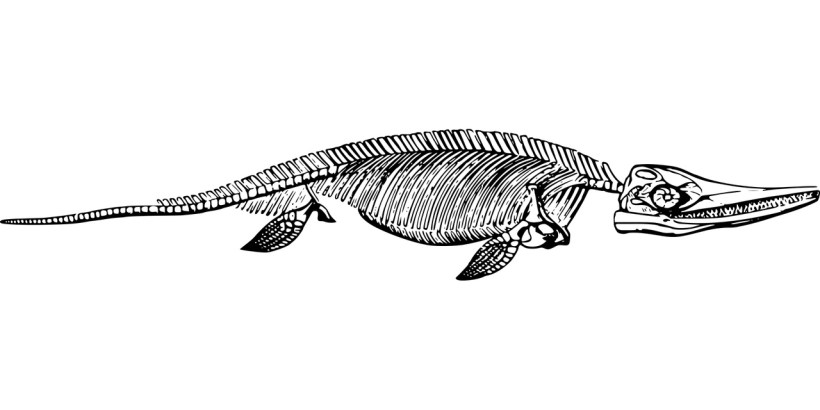
Men sucked whose brains? That would be Mary Anning (1799-1847), the discoverer of some of the world’s most incredible early dinosaur fossils, today on display at the Natural History Museums in New York, London and Paris. Anning’s incredible life story is wonderfully told by Shelley Emling in The Fossil Hunter: Dinosaurs, Evolution, and the Woman whose Discoveries Changed the World. Anning grew up in Lyme Regis on the English Channel. This coastline is now called the Jurassic Coast and is designated an UNESCO World Heritage Site. Mary spent her entire life searching the Blue Lias Cliffs for fossils. She developed this passion from her father who dies prematurely and leaves the family destitute. The family sells the fossils as curios to summer tourists who come to the coast. Mary’s family is an uneducated working class family, and Mary received minimal reading and writing instruction. This makes her story all the more remarkable. She becomes a self-educated paleontologist by studying scientific papers being published by the Royal Society and the geological society. Emling writes, “…she becomes a self-taught expert in the arcana of anatomy, animal morphology, and scientific illustration.” Of course women were banned from all professional societies- they couldn’t even attend the meetings as guests, even when the scientists were discussing their discoveries!

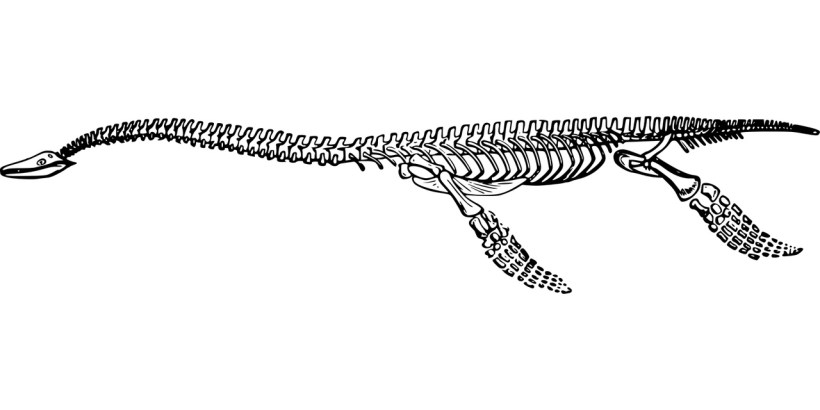
Here’s how it begins: in 1811 Mary and her older brother Joseph find a complete fossil skeleton of an Icthyosaurus which is over 20 feet long. No one has ever seen anything like it! It was the first known extinct animal ever found. They sold it for 23pounds. In 1823 Mary discovered an intact Plesiosaurus! She not only finds them, she painstakingly carves out the fossils from the limestone and shale cliffs, but she also cleans them and sometimes even restores the skeletons. She opens her own fossil shop called Anning’s Fossil Depot and sells to collectors and scientists from all over the world who come to Lyme Regis searching for Mary. In 1828 Mary discovers the first Pterosaur fossil (called a flying dragon) ever found in the UK. The following year, she finds a skeleton of a Squaloraja fish which is in between a shark and a sting ray. In 1830, she finds a new type of Pleiosaur.

Here’s the rub: most of these male scientists who bought her fossils didn’t credit her for the discovery, didn’t name it after her, some even claimed they found it. And these guys made lots of money doing so. Mary, however, supported her family selling fossils, and they were in financial straits most of the time. And these scientists were friends of her’s. Two separate times, two friends did come to her aid. One scientist had a scientific society and the British government award Mary an annual pension of 25pounds which insured she would have the basics in which to live. Another scientist who was a remarkable painter as well, painted an underwater scene of all the fossil fish she discovered. The painting is called “Duria Antiquior.” Paleoart became very popular, and this geological time period was referred to as “deep time.”

Emling tells Mary’s story in a very readable style, but what she does incredibly well is tell how the discovery of these extinct animals rocked the religious and scientific foundations of the time. Most of the scientists were also ordained Anglican priests who were educated at Oxford and Cambridge. Until Mary found the Icthyosaurus in 1811, they had never been in a position to question the accepted belief that the world was 4000 years old. As more fossils were discovered worldwide, scientists had to grapple with the history of the Earth and ancient life not mentioned in the book of Genesis. Many thought that to acknowledge extinction was to admit that God’s creation was imperfect. Some learned people thought that these strange creatures were living in remote parts of the world and really weren’t extinct. Even our own Thomas Jefferson thought that wooley mammoths or mastodons were living in the unexplored west. He told Lewis and Clark to be on the lookout for them. This religion-science divide has never really been settled. It just shows up differently in different time periods. Today it looks like creationism v evolution. Speaking of evolution, Darwin was certainly influenced by Anning’s discoveries- were these animals totally extinct or have they continue to evolve into other types of animals?

Some Ponderings: the Loch Ness monster has been described as a Plesiosaur. And new species of Plesiosaurs are still being discovered. In 1977 a Japanese fishing boat hauled up a 2ton, 32 feet long marine animal body with similar flippers and a long neck. Penn State has sequenced 80%of the genome of wooly mammoths. Jane Austen in Persuasion features Lyme Regis, as does John Fowles in The French Lieutenant’s Woman. James Whistler and JMW Turner painted while visiting Lyme Regis.

#shelleyemling #thefossilhunter #maryanning

Book Club Considerations

Weddings and family seem to the themes this week. I have two books that would make good book club selections because the characters seem to invite discussion.

The first recommendation is Seven Days of Us by Francesca Hornak. I can’t remember where I first learned of this novel, but I’m glad I read it. There’s not always redemption in family sagas, but the novel has some mixed in with heartbreak.

Emma and Andrew Birch have both of their grown daughters home for the Christmas holidays. Phoebe, the youngest and more than a little flighty and shallow has recently gotten engaged to George. Olivia, “a serial aid worker” according to her mother, has just returned home from Liberia where she has been part of an international medical team responding to a Haas epidemic. All medical workers have to be quarantined for 7 days above arrival home. The family has mutually agreed to quarantine together at their ancestral home in the English countryside. Sounded fun in theory. In reality, not so much.

Olivia and Phoebe have nothing in common. Phoebe is obsessed with wedding plans, and Olivia is dealing with culture shock of being back in the developed world, as well as the trauma caused by all she has experienced in Africa. Add to this mix, Daddy Andrew gets an email from an unknown grown son he fathered decades ago while being a news journalist in Lebanon. This young man is emailing that he will be in the region over the holidays and would like to meet his birth father. So what does Andrew do? He deletes the email in believing it makes this little inconvenience go away. Bad move on Andrew’s part. And Emma, sweet accommodating mama Emma? She has a secret too- one that undoes her family in the midst of an already stressful holiday.

An underlying thread in the plot is the resilience of family ties- how love and grace helps to oil the cog of relationships. Redemptive situations never takes us back to how things were in the beginning, but they can take us forward. There is so much in his book to discuss over a good glass of wine!

The second recommendation is By Invitation Only by Dorothea Benton Frank. What is so unusual about the book is that the characters’ names are the names of actual people. It was part of a fundraiser- people paid for Frank to use their name in one of her books. I’m not sure how she determines who are the “villains”and who is not.

This is the story of two families- one is an old Lowcountry peach farming family from South Carolina who are the hardworking salt of the earth. The other is a wealthy family from Lakeshore Drive in Chicago. Their children fall in love and wedding plans begin. How does a peach farming woman relate to a hedge fund wife who thinks nothing of spending $40,000 on butterflies to be released at the reception? It’s a comedy of manners and faux pas until the hedge fund father of the bride is arrested in a Ponzi scheme. The comeuppance becomes a story of redemption for some of the characters.

Speaking of characters, you will love them, except for a few uber witches thrown in for spice. Frank’s characters are truthful, empathetic and realistic. We’ve all known these folks regardless of where we live. If you’ve ever been the mother of a bride or groom you’ll relate to trying to tiptoe through sticky situations. This is a great book selection. It’s fun and funny!

#sevendaysofus #francescahornak #byinvitationonly #dorotheabentonfrank

She Has Her Mother’s Laugh

The full title is She Has Her Mother’s Laugh: The Powers, Perversions and Potential of Heredity. It’s written by Carl Zimmer, a science journalist, who also teaches at Yale. I heard Zimmer interviewed on NPR recently, and what appealed to me was that our family did the ancestry test with 23andMe. In fact, Santa gave the tests to all of us and to my sister this past Christmas. I learned so much about genetics and biology in Zimmer’s book, and that really says something for someone who barely squeaked out a C in freshman biology in college- actually it may have a D. I mean, the class met at 8:00 in the morning. How was I supposed to help shut down my favorite bar and then learn molecules, chromosomes and cells mere hours later? It’s not humanly possible! My disclaimer is I know nothing about all this stuff, so any errors are mine, not Zimmer’s.

I want to talk about two aspects of this hugely informative book, emphasis on the hugely part. It’s 656 pages, BUT the last 100 pages consist of endnotes and bibliography. Truth is- it’s a fascinating read because it’s all told in story form. It’s not a textbook. It’s a composite of stories about the people who have worked in biology and genetics for the past several hundred years with plants, animals and humans. Zimmer has an incredible ability to make really complicated information understandable to non-science people.

So one of the aspects I want to talk about is Neanderthals. I always thought they were some sub-human hominid, but they are not. They mated with modern humans, made their own tools, hunted large game, wore jewelry and made sculpture out of stalagmites. According to 23andMe, I’m part Neanderthal- 292 variants. The highest number of Neanderthal variants 23andMe has seen is 400. I have more than 75% of their DNA. So other than knowing how to cook game, use tools, love sculpture and wear jewelry, what else do I have in common with my ancient family? I have straighter than normal hair and less than average height. If I were a guy I would have back hair, but I don’t since I’m not. It’s thought that Neanderthal DNA is good for our immune system because it has a lot of immune fighting genes. Zimmer says thanks to 23andMe, Neanderthal pride is a real thing. Zimmer also says the Neanderthal test is not very accurate. But nevertheless….

In 1856, Neanderthal bones were first discovered in Neander Valley in southern Germany, hence their name. There is evidence that Neanderthals bred with modern humans during three different time periods in three different places- Europe, Near East and East Asia. At the turn of the 20th century in a cave on Mount Carmel in Israel, bones were discovered with modern human DNA and Neanderthal DNA. In 1995 mitochondrial (from females) DNA was taken from Neanderthal fossils from the Neander Valley, and by 2010 scientists had 60% of the entire Neanderthal genome built. A genome is “the complete sequence of DNA in an organism.” This is remarkable considering we’re talking about fossils that are several hundred of thousands of years old.

The second aspect I want is to talk about is “leaky” placentas. When pregnant, the circulation system connecting mom to baby is not a one-way highway. Cells migrate back and forth. What does this mean? According to Zimmer’s research, mothers of biological sons may carry some of their boys’ Y chromosomes in their bodies until they die. Research as shown that sons’ Y chromosomes lodge in their mothers’ organs and have been found through autopsies. Two things about this. Women are more prone to autoimmune conditions. Some scientists think our bodies COULD be fighting off our sons’ Y chromosomes since women do not have any Y chromosomes. Females are XX and males are XY. Other scientists think the sons’ Y chromosomes could help their mothers fight off cancer and other diseases. There are Y chromosomes that have been found in healthy breast tissue of women fighting breast cancer.

So this swapping of chromosomes between mothers and sons helps explain why my son, He Who Must Not Be Named and I stay in each other’s heads. Because we do! Brains are one of the organs Y chromosomes have been found. He tries unsuccessfully to influence me to think more to the right, and I try unsuccessfully to influence him to think more to the left. Not sure where stubbornness shows up on the human genome, but it’s there somewhere. Now Zimmer doesn’t say this, but I have deducted (remember the biology grade!)that during pregnancy mothers are also swapping out cells with their daughters. But since all females are XX, I’m assuming scientists can’t tell whose X is whose. Meaning scientists can’t tell apart the cells my daughter Ellie gave me and what were mine to begin with. Taking that step further, I would have X chromosomes my mother Shirley shared with me. Right? Share and share alike….

This chromosomal sharing makes for some interesting ramifications. We like to think surrogacy is like baking your bread in your neighbor’s oven, but it’s more than that. Zimmer doesn’t shy away from discussing this. He writes, ” In 2009, researchers at Harvard did a study on eleven surrogate mothers who carried boys but who never had boys of their own. After the women gave birth, the scientists found Y chromosomes in the bloodstreams of five of them…surrogates-to-be need to give informed consent that’s truly informed. It may come as a surprise to them that their own DNA could have a long-term influence on the health of an unrelated child, and that they may end up with some of the child’s cells-complete with a separate genome. These women need to know that heredity’s tendrils can’t be pruned as easily as we might imagine.”

Fascinating, yes? Also there is good information in this book about genetic screening to rule out disease-causing mutations in yet unborn children. There’s discussion about the desire of some to create a super-child who is brilliant, beautiful and disease free. This may be obtainable to couples in affluent developed countries, but what about the masses of humanity whose children would continue to suffer with diseases without adequate medical care in developing countries? Lots of ethical discussions that Zimmer handles eloquently.

I’ve never read a book like She Has Her Mother’s Laugh. It’s taken me all summer to read it and wrap my head around it. It has been the most meaningful endeavor of my summer. I find myself thinking about what I’ve learned all throughout my day. It’s not for everyone, but I highly recommend tackling this fascinating subject.

#carlzimmer #shehashermotherslaugh #genetics #neanderthals #surrogacy #23andMe

Who Are Those People, really?

We are hearing a lot about the country of Iran these days, and it’s a very political narrative. My generation certainly remembers the overthrow of our embassy in Iran in 1979, and our embassy’s 52 personnel taken hostage for 444 days. Anyone remember watching Ted Koppel every night? We know Iran chants “Death to America” a lot. But I wanted to learn more about this isolated, mysterious country of Iran. Who are these people, and how did they come to be an Islamic Republic? That term alone almost sounds like an oxymoron- Islam and a republic. So I turned to Scott, a best friend and colleague of my daughter and son in law. Scott is from Greensboro, NC and worked with my daughter and son in law in Turkey for several years. Scott is presently finishing a Master degree in Middle Eastern Studies at the University of London. I asked him what book I should read to help me understand this country. He recommended Iran: Empire of the Mind: A History from Zoroaster to the Present Day by Michael Axworthy, who is British expert of Iran. Also Scott recommended I watch “Our Man in Tehran” a 2-part documentary on PBS Frontline. This documentary was filmed over 4 years by Thomas Erdbrink, the New York Times Bureau Chief who has lived in Tehran since marrying an Iranian woman 17 years ago. Erdbrink is one of the last foreign journalists in Iran.
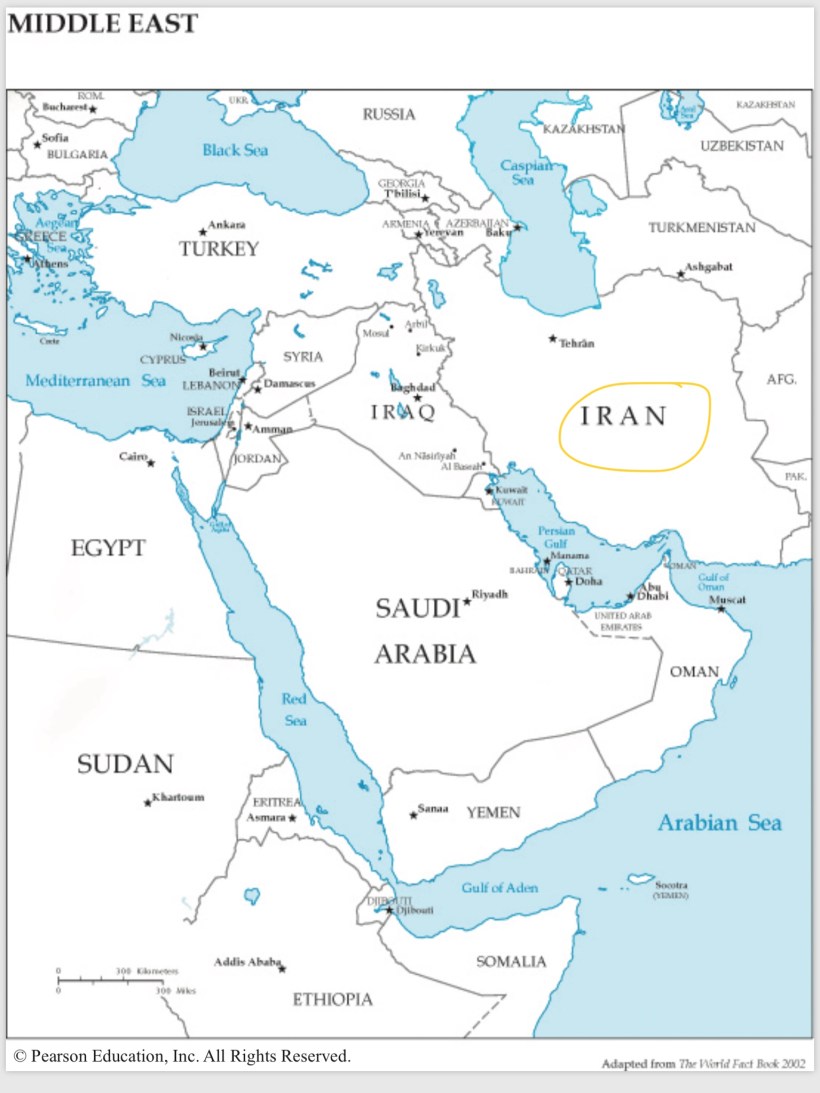
So here is what we know: Iran, a country of 81 million people is located between Iraq and Turkey on the west and Turkmenistan, Afghanistan and Pakistan on the north and east. It has the Caspian Sea to the north, and the Persian Gulf/Sea of Oman to the south. It is a beautiful country of seashores, mountains, deserts and arable land. Its crops include varieties of cereals, veggies and fruits, including figs and pomegranates. Iran produces the world’s largest amounts of pistachios, saffron and raisins. The people are not Arabs, but Persians, a people group who speak Persian, not Arabic. Iran is one of world’s oldest civilizations going back to 4 millennium BCE. The West had always called it Persia because the ancient Greeks called it Persia. In 1935, the then-Shah asked the international community to refer to the country as Iran (pronounced e-ron with a long e vowel sound). The largest indigenous religion was Zoroaster, an unusual religion going back to the second millennium BCE. It is a monotheistic religion influenced by Christianity, Judaism, Gnosticism and Islam. Iran became Muslim due to the many times it was conquered by Muslim warlords over the centuries. In 633, Iran was conquered by a Sunni warlord. In the 1400s, the country formally became Shia/Shiite because of the Safavids who took over Iran. This was a turning point in the national identity of Iran. Interesting enough, since the overthrow of the Shah in 1979, Zoroastrianism is having a bit of a revival as a pushback against radical Islamism.

Iran is a country of very educated citizens. They love music and poetry. Both Axworthy and Erdbrink talk about this love of culture, and both mention the poet Hafez who has been dead for centuries, but Iranians love to visit his grave, and all ages can quote his poetry. How many Americans can quote from our famous poets, like Dickinson, Whitman or Frost? The West is more familiar with the Persian poet Rumi who was born in 1207 and who had a spiritual awakening when he began to study under the Sufi master Shams of Tabriz. His poetry took on a mystic quality as he called himself the Beloved of God. Beautiful poetry- if you’ve never read any of it, please do.

Erdbrink’s documentary reveals the arbitrariness of the Iranian “morality codes”- meaning head scarves have to cover not only a woman’s hair but her neck as well. No wrist or ankles may show in public- meaning socks and shoes at all times and sleeves to the wrist bones. The Morality Police (yes, their name) are responsible for maintaining societal control by policing the streets looking for offenders. Risk-taking and fear go hand in hand in Tehran. In smaller towns and more rural communities, the chador is required. A chador looks like the full flowing burka except you can see the woman’s face. The chadors are predominately black in Iran. Women can drive and work outside the home, and they do not have to be accompanied by a male relative in public like in Saudi Arabia. (Last month, Saudi eased the restriction on women driving).

Axworthy writes of the long and often tumultuous relationship Iran has had with Russia over the centuries. The Persian Empire over the centuries often butted up to territories that Imperial Russia wanted under the various tzars. Russia has always needed and will always need warm water ports for commerce. Iran and Russia officially began diplomatic relations in 1521. They are sometimes allies and sometimes enemies. As my Dad would say, they are definitely “bedfellows.” With US sanctions against Iran, the country does a lot of trade with Russia. Because of the tense relations Iran has with the US and the West, there is not a lot of growth in the private sector. According to Erdbrink, there is little private investment and no foreign investment. Hence many educated Iranians are underemployed and frustrated.

Politically, Iran is a “Theocratic-republican totalitarian unitary presidential republic subject to a Supreme Leader” (Wikipedia). This appears to be the problem. Citizens, including women can vote for their leaders who have been approved by the Supreme Leader Ayatollah Khamenei and his fellow hardliners. Rouhani was elected president several years ago as a moderate. People really felt he would establish more freedoms for the citizens, except he really can’t. He is locked in by the Ayatollah who has totalitarian control in the name of Islam. Rouhani was able to increase the speed of the internet for the country ten fold which has made Instagram the most popular form of social media. The President himself has 1.9 million followers, and the Ayatollah has 1.6 million followers. A tremendous amount of western influence comes into the country via the internet which does not make the hardliners happy. Rouhani has also enabled coffee shops to open and flourish in the cities where the young crowds can listen to western music, freely mix together, and the women brazenly wear their head scarves on the very back of their heads showing a lot of hair and neck. Unfortunately this is not enough freedom for many Iranians. However, when the citizens take to the streets in protests, the hardliners use the chaos and unrest to only tighten their control.

Even though Americans often see images of Iranians in the streets burning our flag and chanting “Death to America”, Erdbrink says these haters are in the minority. Most citizens want to come to America to visit or live. They want our freedom of expression and speech. One of the journalists Erdbrink interviews says the hate of America is built into the political narrative. Iran has to have a scapegoat to blame for its troubles. Iran’s isolation from the rest of the world helps the hardliners blame the West. Problem is the internet tells a different story to the citizens.

Scott has graciously agreed to let me interview him in September after he turns in his dissertation which is on the Islamic Republic of Iran. He will be able to give us information which as citizens we need. I look forward to that interview.

#michaelaxworthy #iran #ourmanintehran #thomaserdbrink #pbsfrontline

pbs.org/frontline

Trees, Lovely Trees

A SUDDEN LIGHT by Garth Stein

You may recognize Garth Stein’s name from his popular book The Art of Racing in the Rain. Stein hits another home run with A Sudden Light. It’s a six-generational family saga, a coming of age story and a ghost story all rolled into one great book.

Trevor Riddell, age 14, goes with his father to visit the family home place in the Northwest, a magnificent mansion built at the turn of the 20th century. Riddell House is built on 200 acres of park-like timber land and was built by patriarch Elijah Riddell. Elijah was a robber baron of the worst kind and was responsible for clear cutting thousands and thousands of virgin forest. He made fortune upon fortune doing it. The exterior of this house is made of 50 foot tree trunks which symbolize the family wealth. Also symbolic is the derelict condition of the house and the loss of the family fortune over time.

Because Trevor’s father, Jones Riddell was estranged from his family, Trevor is shocked by this property and shocked by his strange Aunt Serena and demented grandfather Samuel who live in this house. He is also shocked by the two ghosts who also continue to live in the house, his grandmother Isobel and his great uncle Ben. Trevor sets out in true teenage boy, Tom Sawyer fashion to “find the truth.” This huge house has innumerable rooms and hidden passages which Trevor uses while doing his investigative work. And he succeeds. He finds the disheartening truth amidst a tragedy that forever changes his life and the lives of subsequent generations. Trevor is an adorable character and just like with our own teenage boys, you love him in spite of that underdeveloped frontal lobe!

Garth Stein just doesn’t throw in a couple of ghosts into the plot line for fun. During the turn of the 20th century, Spiritualism was a popular belief system that claimed spiritual guides could communicate with the dead. The dead could offer guidance, knowledge or relate their love of the still-living. This communication could be done through seances or automatic writing. It was believed that the spirits of the dead could visit the living, could move objects and directly communicate as well. Mary Todd Lincoln believed in Spiritualism and had seances to try and communicate with her dead son. Also World War 1 with its mass casualties gave opportunities for believers to try and communicate with dead loved ones. It’s really a fascinating side note in American history. So the author uses Spiritualism as a vehicle to have dead characters participate in the plot line. Uncle Ben passes on information to Trevor that no one else knows.

It was poignant to read this novel after finishing The Overstory by Richard Powers which I reviewed a couple of weeks ago. Elijah Riddell is characteristic of the villains in The Overstory- clear cutting swaths of virgin timber with no forethought of preservation or conservation measures. Elijah despises President Teddy Roosevelt’s efforts to preserve land by establishing national parks. To Elijah it was a waste of good timber, and therefore a waste of potential earnings. Uncle Ben, however, would be a hero in Power’s book because Ben understood and loved the environment on the same deep level that many do today. The two books make good companion readings, even though I discovered that serendipitously.

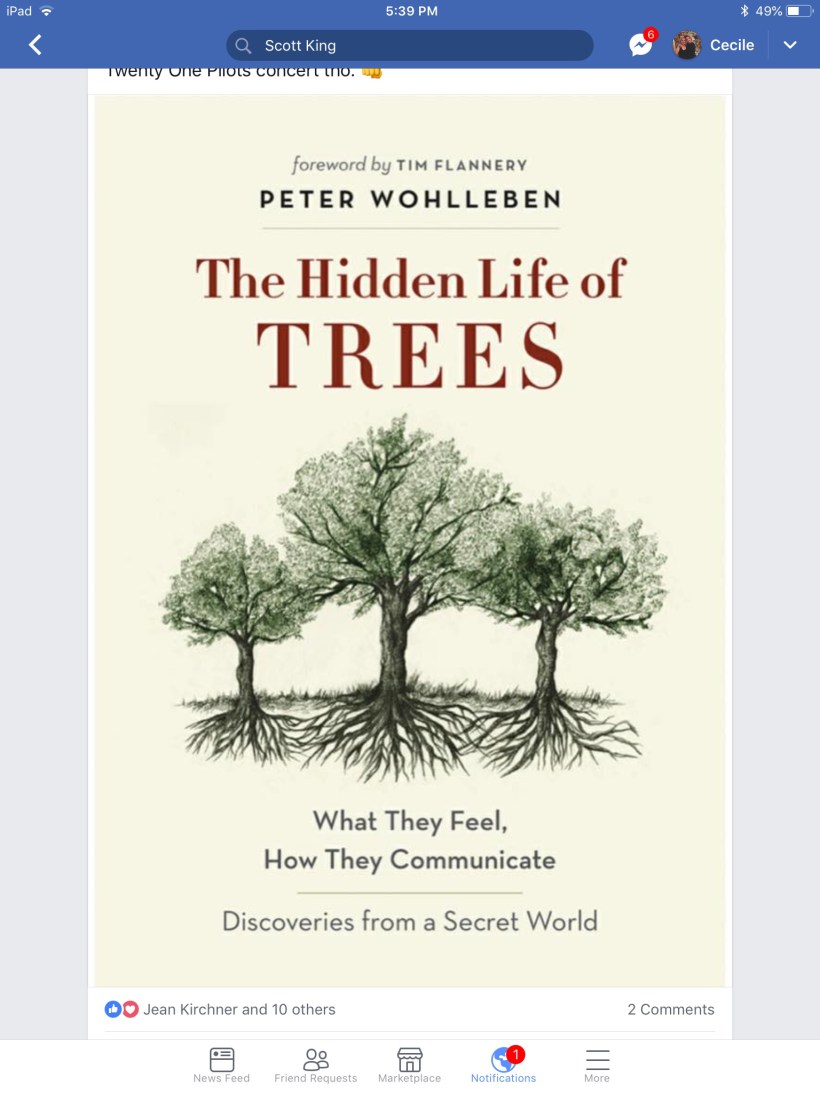
Another book on my list to read is The Hidden Life of Trees by Peter Wohlleben. I read a review of this book on the blog Brain Pickings, then casually mentioned it to my sister-in-law Kim. She told me this was the book her husband/my brother Scott was reading last summer when he died suddenly of a heart attack. I screened shot the cover from his Facebook page as you see below. Growing up my siblings and I were always out in the woods and always climbing trees. I still have a crooked bone and scars from my falls. I expect this book will touch some tender spots in my heart.

#garthstein #asuddenlight #richardpowers #theoverstory #spiritualism #robberbarons

Reading for the Dog Days of Summer

The Forgers by Bradford Morrow

Several weeks ago I reviewed The Prague Sonata by Bradford Morrow, and I liked his writing so much, I now have read The Forgers. He writes so well- great characters, a clipping pace, creative plot lines. I really enjoyed this book. The Forgers is set in NYC and Ireland in contemporary times. Adam is murdered, but who did it? Henry or Will? They are pointing fingers at each other. All three of these men represent the dark side of the world of rare first-edition books and manuscripts. They are forgers- as in forgering dead author’s inscriptions to increase the value of the book, forgering letters and manuscripts supposedly written by famous literary figures. And these guys are good! They have been fooling the bibliophile community for a long time. Lots of shady money to be made. So who killed Adam and why? Lots of questions and lots of deceit- a perfect book for a hot summer afternoon.

The Other Side of Silence- A Bernie Gunther Novel by Philip Kerr

I have always had a secret passion for spy novels, especially Cold War spy novels. When the Berlin Wall fell and the USSR crumbled, I muttered that there goes a great genre of fiction writing. My husband was aghast. I did feel a little guilty for saying that.

Well, I was wrong. Philip Kerr in The Other Side of Silence writes a wonderful Cold War spy novel that even has Nazis in it! What attracted me to this book is that Somerset Maugham is a central character. Maugham, the famous British playwright and novelist is being blackmailed by an ex-Nazi turned Soviet spy. Maugham’s homosexual lifestyle has left him vulnerable to blackmail, and he turns to the star of this series, Bernie Gunther to help. The setting is mainly in the south of France, and there’s lots of champagne and gin involved.

This novel is layered with historical facts that takes it beyond just a good novel. In real life, Maugham was a British spy in Russia in 1917. During the early Cold War years M15and M16 in the UK had several notable moles, double agents like Kim Philip, Guy Burgess and Anthony Blunt. In fact it has been long considered that Sir Roger Hollis, director of M15 from 1956-1965 was a mole. It is still being debated on both sides of the Atlantic. These men make appearances in The Other Side of Silence.

Maugham wrote a collection of short stories entitled Ashenden: or the British Agent, which the main character is a gentleman spy. Some say Ashenden was the inspiration for Ian Fleming’s character James Bond. Maugham uses his experience as a spy as the basis for these short stories. He was known to use a lot of autobiographical material in his writings. Story has it that Winston Churchill advised Maugham to destroy over a dozen of his spy stories because of Britain’s Official Secrets Act.

I will read more of Philip Kerr. He is an accomplished writer who can take the reader on an incredible journey into the underbelly of the espionage world. It’s so fun!

The Strays, A Novel by Emily Bitto

Australia, 1930s-1940s Bohemian art community centered in the home of eccentric avant- guarde artist, Evan Trentham, his wife Helena and their three daughters. The narrator is Lily, best friend of Eva, the middle daughter. Lily is mesmerized by the artists, the debauched lifestyles and of course, Eva. In present day, Lily is forced to think back on the sweet time of girlhood when a best friend made the world go round. Unfortunately the debauchery has caught up with this family in ways unimaginable, and relationships may be beyond salvaging. The perfect book for a dog-day summer weekend.